
Fully Submersible Wi-Fi Antenna for Marine and Underwater Applications – DNC-2192 Explained
Dec 12th 2025
When Water Is the Enemy of Wi-Fi: The Story Behind the DNC-2192
Anyone who has ever tried to use Wi-Fi near water learns the lesson quickly: water and radio signals don’t get along.
Salt spray, humidity, waves, and full submersion turn ordinary antennas into unreliable weak points. For underwater cameras, ROVs, research sensors, and marine platforms, the problem isn’t just signal loss — it’s trust. Trust that the connection will still be there when the system is already deployed, submerged, and mission-critical.
That challenge is exactly what led to the creation of the DNC-2192 Fully Submersible Wi-Fi Antenna.
A Real-World Problem We Kept Seeing
At Dive And See, we regularly work with customers who operate:
- Underwater cameras and live-streaming systems
- ROVs and tethered underwater drones
- Buoy-based communication platforms
- Research and industrial monitoring equipment
Many of them were already using our DNC-2129 Wi-Fi antenna, a proven and rugged design for marine environments. But the feedback was consistent:
“We don’t always want the antenna fixed right at the receiver.”
“We need to mount the antenna on a buoy or external structure.”
“We want flexibility without extra connectors underwater.”
In other words — the antenna needed to move, but reliability could not.
Why Permanent Cable Matters Underwater
In dry environments, detachable connectors are convenient. Underwater, every additional connector becomes a risk point.
So instead of adding more complexity, we went the opposite direction.
The DNC-2192 keeps the exact same RF performance as the DNC-2129, but introduces a permanently attached, waterproof, high-frequency coaxial cable (up to 3 meters).
- No extra underwater couplings
- No exposed interfaces
- No compromises in signal integrity
Just a clean, sealed RF path from the antenna to surface electronics.
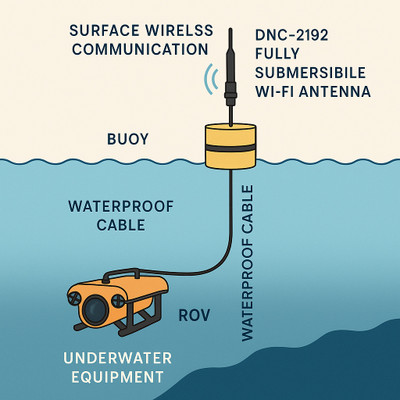
How the System Really Works
A common misconception is that Wi-Fi can travel long distances underwater. It can’t.
The real solution is smarter:
- The antenna is mounted where it makes sense — often on a buoy, hull, or external structure.
- The waterproof RF cable routes the signal above the waterline.
- From there, standard Wi-Fi equipment takes over: routers, access points, laptops, and tablets.
The DNC-2192 is designed specifically for this surface-tethered communication model, where stability matters more than theoretical range.
Built for the Ocean, Not the Lab
Every physical detail of the DNC-2192 exists for a reason:
- Marine-grade aluminum body for corrosion resistance
- Hard anodized coating to protect against abrasion and saltwater
- M18 threaded mount for secure and repeatable installation
- 5 mm OD waterproof 50-ohm coax cable for flexibility and low RF loss
- Crimp-compatible cable end supporting N-type, SMA, or TNC connectors
This is not a consumer antenna adapted for water. It is a marine component designed from the start for wet, exposed, and submerged environments.
Where the DNC-2192 Is Used
The DNC-2192 is built for professionals who don’t get a second chance once the system is in the water:
- Marine researchers collecting long-term data
- Engineers deploying ROVs and inspection platforms
- Film crews running underwater live feeds
- Operators mounting antennas on floating buoys
- Industrial users working in splash-zone or high-humidity environments
In all these cases, the antenna isn’t just hardware — it’s the bridge between underwater systems and the surface world.
A Small Change That Makes a Big Difference
On paper, the difference between DNC-2129 and DNC-2192 looks simple: detachable cable vs permanent cable.
In practice, that change dramatically improves:
- Reliability
- Installation flexibility
- Long-term durability
- Confidence in harsh marine environments
That’s what the DNC-2192 is about: removing uncertainty from underwater wireless systems.
Looking Forward
As underwater technology continues to move toward real-time data, live streaming, and remote control, surface communication becomes more important than ever.
The DNC-2192 Fully Submersible Wi-Fi Antenna is a small but critical part of that ecosystem — built for professionals who need their equipment to work not just in theory, but in the real ocean.
If you’re building something that goes in the water and needs to stay connected above it, this antenna was made for you.